Lubbock Coolers
A direct-to-consumer storefront for a custom cooler business I founded, built around a configurator that lets customers preview their order before purchase.
Background
I started painting custom coolers for events like Greek life formals, gifts, and more in Lubbock in March 2025, taking orders by text and on Instagram. Demand was there, but the process was the constraint. Each sale required days of messaging clarifying unclear ideas, all with tight deadlines.
I own product strategy, customer experience, and daily operations, so the site was built to solve a real business problem: making the customization process more efficient and reducing the need for back-and-forth with every customer
Twenty units sold, with every iteration since launch prioritized from customer feedback or funnel data.
- Owned the product end-to-end: Product strategy, customer experience, and daily operations, from first conversation to shipped order.
- Designed, developed, and launched the site: Including an interactive 3D product preview that lets customers rotate the product and preview custom uploaded artwork before ordering.
- Sold 20 units and used the feedback: Direct customer input improved both the product design and the ordering flow, supported by an analytics dashboard tracking the purchase funnel and acquisition channels to pinpoint drop-off and prioritize UX fixes.
Understanding the problem
Every order began with the same friction. Customers wanted a painted cooler but could not clearly communicate what they were visualizing on their own, so each sale required days of photos and communication gaps over text. Based on customer feedback, I noticed three major areas of improvement:
- Uncertainty was the primary objection, not price. Customers could not picture their own design on the product.
- Buyers wanted to control specific sides of the cooler, not approve a single finished mockup.
- Quoting was an issue. Painting one lid and painting all five panels and four corners are very different jobs, and pricing each order by hand did not scale and was never exactly accurate
Product vision and solution
From those findings I set three goals for the product:
- A customer should see their own artwork on the product before paying.
- Price should be transparent and update as the customer builds the order.
- I should be able to fulfill an order without a single message exchanged.
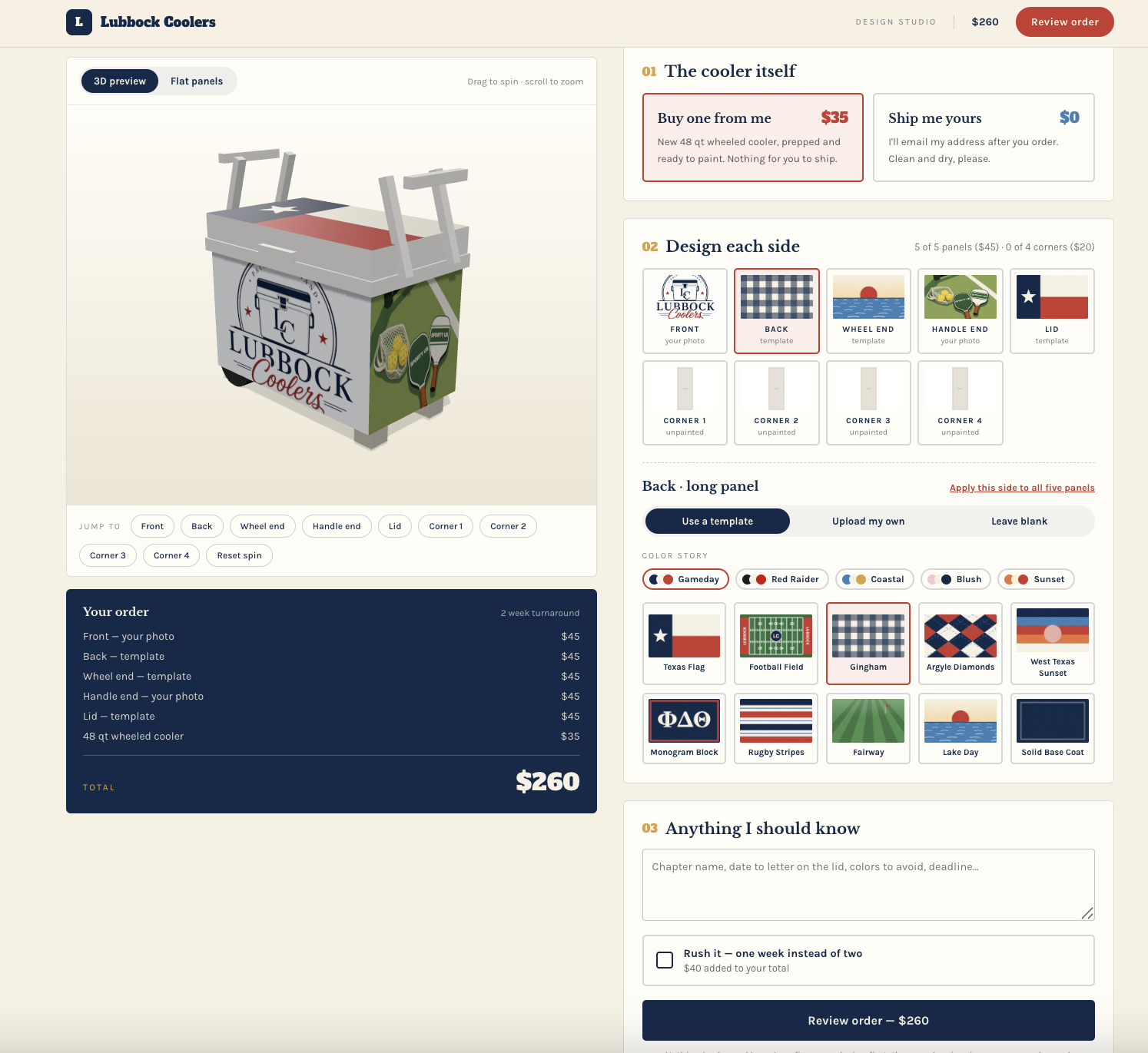
The result is a storefront with a design studio at its core. Customers select a template or upload their own artwork per panel, rotate a 3D model to evaluate it, and watch the price update in real time, removing the uncertainty when it was time to purchase.
Defining the MVP
I kept the first version focused on the most important customer decisions
- Preview before payment: The objection was always about what the final product would look like. Answering it on the page with minimal clicks and the ability to upload images directly removed days of back-and-forth.
- Priced per panel: Not per cooler. A single-side order becomes a real entry point, and the five-side wrap reads as the upgrade.
- Bring your own cooler for $0: It costs me nothing and removes the biggest reason customers walked away.
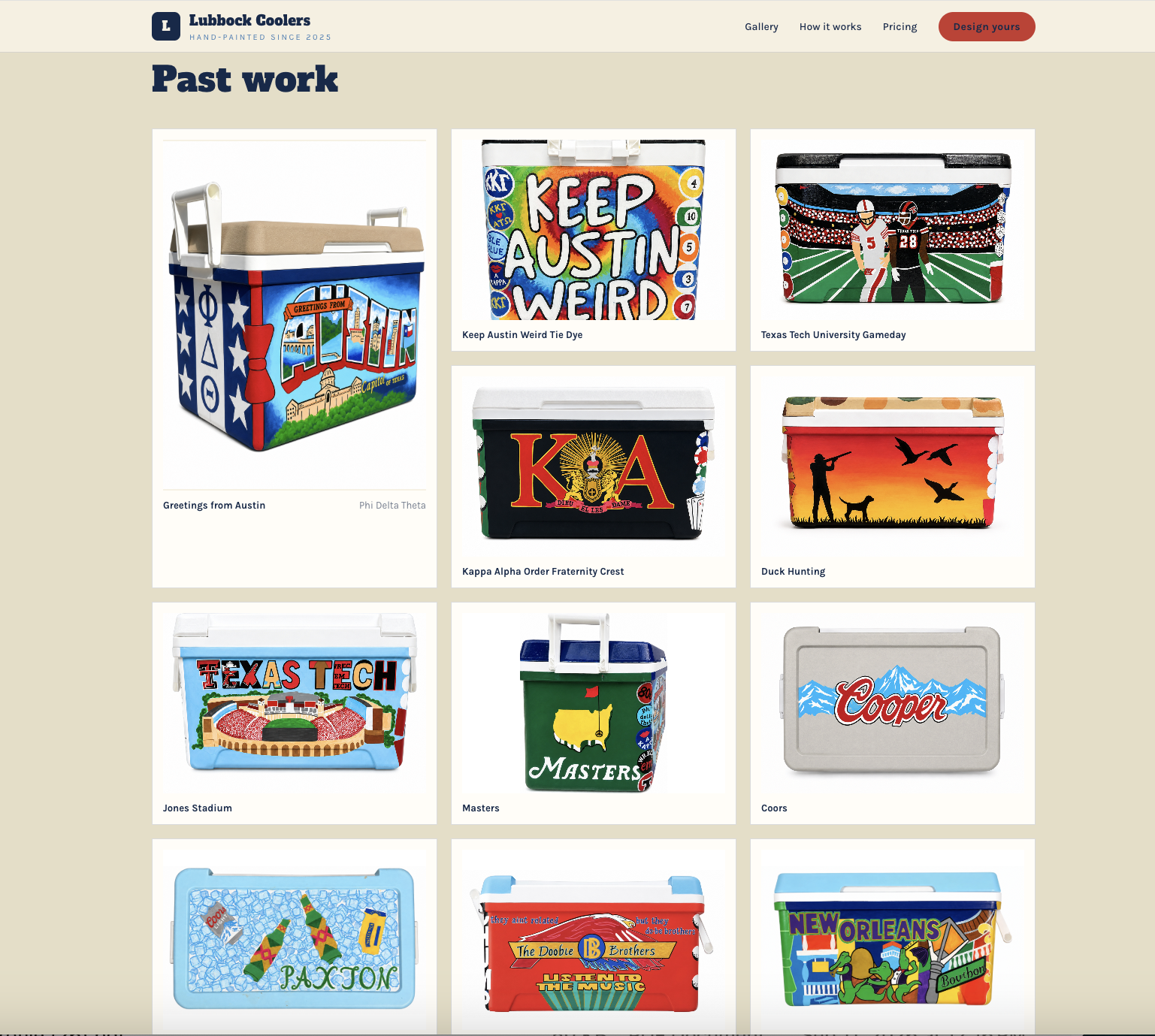
- Proof of past work: A gallery of finished coolers painted by me, so customers have confidence that their design will be up to their standards.
Measuring the funnel
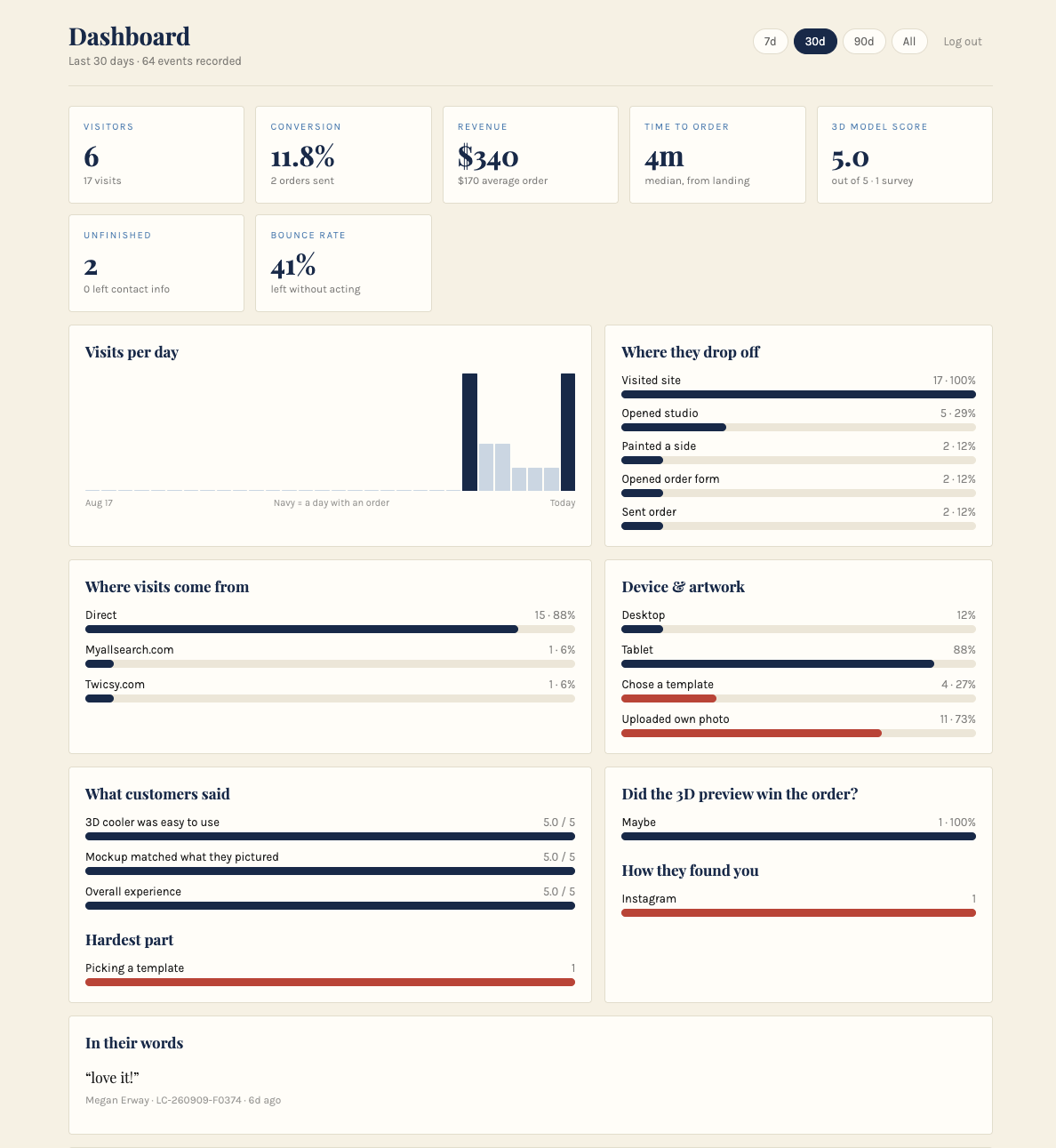
I instrumented the site to measure where users drop out. Most visitors never reach the studio, and those who do overwhelmingly upload their own artwork instead of selecting a template. Survey responses independently named template selection as the hardest step, which validates the behavioral data.
That gives me the next iteration: fewer, better templates, and a clearer path from the homepage into the studio.